

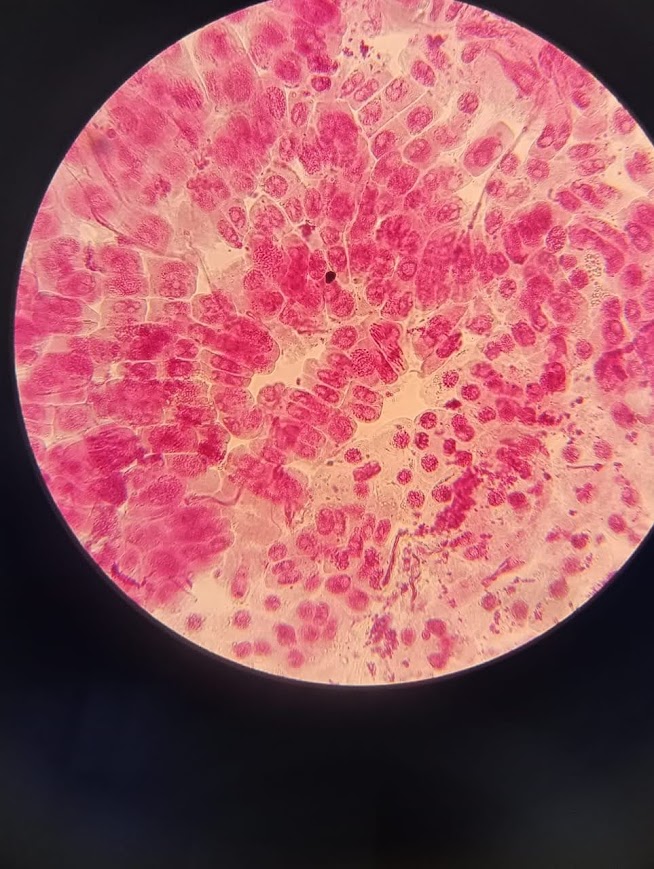
What Is Mitosis?
Mitosis is the process by which a single cell divides into two genetically identical daughter cells. It is a fundamental mechanism that drives growth, tissue repair, and reproduction in multicellular organisms. Understanding mitosis is essential not only for biology students but for anyone curious about how life perpetuates itself at the cellular level.
The Phases of Mitosis
Mitosis is divided into four major stages, each precisely coordinated to ensure accurate chromosome segregation:
Prophase
Chromosomes condense and become visible under a microscope. The mitotic spindle begins to form from the centrosomes, which migrate to opposite poles of the cell. The nuclear envelope starts to break down.
Metaphase
Chromosomes align along the cell's equatorial plate — the metaphase plate. Each chromosome's centromere attaches to spindle fibers from opposite poles. This alignment ensures each daughter cell receives exactly one copy of each chromosome.
Anaphase
Sister chromatids are pulled apart toward opposite poles of the cell as spindle fibers shorten. This is one of the most visually dramatic stages of mitosis.
Telophase
Nuclear envelopes reform around each set of chromosomes. Chromosomes begin to decondense. The cell prepares for cytokinesis — the physical division of the cytoplasm.
Cytokinesis
Although technically separate from mitosis, cytokinesis immediately follows and completes cell division. In animal cells, a contractile ring of actin pinches the cell in two. In plant cells, a cell plate forms between the two daughter nuclei, eventually becoming a new cell wall.
Why Mitosis Matters
Every tissue in your body — from the lining of your gut renewing itself every few days to the healing of a wound — depends on mitosis. When errors occur in mitosis, chromosomes can be distributed unequally, potentially leading to conditions like cancer. Understanding mitosis therefore has profound implications for medicine, particularly in oncology and developmental biology.
Mitosis vs. Meiosis
Students often confuse mitosis with meiosis. The key distinction: mitosis produces two genetically identical diploid cells for growth and repair, while meiosis produces four genetically unique haploid cells for sexual reproduction. Both processes share some structural similarities — including the formation of a spindle apparatus — but serve entirely different biological purposes.
Teaching Mitosis in the Classroom
As a professor of anatomy and physiology, I find that visual models and hands-on activities make mitosis click for students. Using pipe cleaners to simulate chromosomes, or watching time-lapse footage of dividing cells, transforms an abstract concept into something tangible and exciting. Mitosis is where molecular biology meets the visible world — and that intersection is one of science's most beautiful stories.

Discussion (0)
Leave a Comment